Wholesale Coffee Beans for Small Cafes: 2026 Guide
Oct 2, 2026 (Updated on Oct 5, 2026)
Table of Contents
- What Wholesale Coffee Beans for Small Cafes Really Cost
- How to Choose a Coffee Supplier for Your Cafe
- Choosing wholesale coffee beans for a small café
- Best Wholesale Coffee Beans for Cafes: Matching the Roast to Your Menu
- Coffee Equipment and Training for Cafes: What Good Suppliers Provide
- Managing Stock, Lead Times and Waste in a Small Venue
- How to Order Wholesale Coffee Beans from Baffled Coffee
- Conclusion
- Frequently Asked Questions
Last Updated: October 2, 2026
What Wholesale Coffee Beans for Small Cafes Really Cost
Wholesale coffee beans for small cafes are the single biggest variable cost in your drinks menu, and the one most often misjudged. Most owners compare price per kilo and stop there. That's the mistake. The real figure is cost per cup, and it changes with dose, waste, and how often you reorder.
The True Cost of a Kilo: What a Trade Account Should Cover
Price per kilo tells you very little on its own. What matters is what sits inside that price. A good trade account includes freshly roasted beans, a roast date you can see, and a grind matched to your equipment. It should also include a clear reorder process and someone who answers when something goes wrong.
How to Work Out Your Cost Per Cup
This is the calculation most wholesale pages skip, and it's the one that decides whether your coffee is profitable. You need three numbers: your cost per kilo, your dose per shot, and your wastage.
Watch OutNever buy a month of stock to chase a bulk discount. Coffee loses its best flavour within a few weeks of roasting, and a pallet of fading beans costs you more in wasted shots than the discount ever saves.
Recalculate your cost per cup whenever you change dose, basket, or supplier. A recipe change of 2g per shot moves your margin more than most owners expect.
What to Look For Beyond the Price
When you compare trade accounts, ask what's included at the price. Freshness, roast date transparency, grind matched to your equipment, and responsive support all have a cash value. A supplier who dials in your grinder on delivery day is saving you wasted grams every single service. A supplier who answers the phone on a Saturday is saving you a bad review.
How to Choose a Coffee Supplier for Your Cafe
Choosing a coffee supplier for your cafe comes down to consistency, not charisma. The supplier who turns up on time with the same roast every month beats the one with the most exciting origin story.
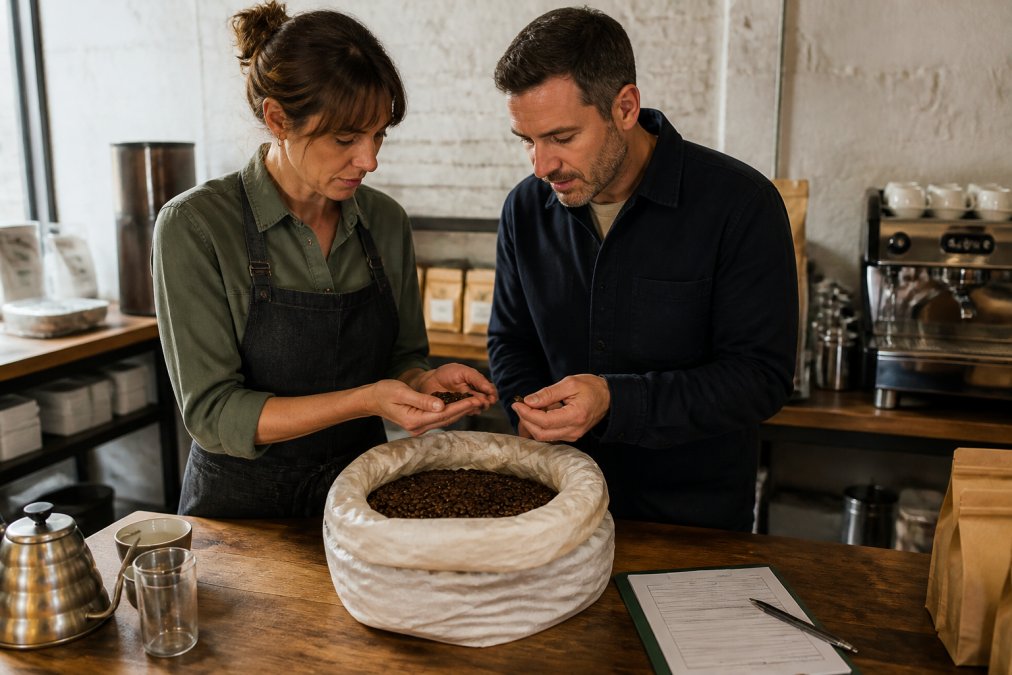
Choosing wholesale coffee beans for a small café
Five Questions to Ask Before You Sign a Trade Account
- When is the coffee roasted, and is the roast date printed on the bag?
- Can you supply whole bean and ground to order for our brew method?
- What are your delivery lead times, and what happens if an order is late?
- Do you offer barista training or dialling-in support?
- What are the minimum order quantities and how flexible is the account?
Ask these before you commit. Vague answers on roast dates or lead times are a warning sign.
Best Wholesale Coffee Beans for Cafes: Matching the Roast to Your Menu
The best wholesale coffee beans for cafes are the ones that suit how you actually serve coffee. A medium roast blend is the safe backbone for most venues. It holds up in espresso, works with milk, and tastes familiar to customers who order the same thing every day.
Single-Origin or Blend? What Most Cafes Actually Serve
Most cafes serve a blend as their house coffee. Blends are easier to keep consistent year to year, because the roaster can adjust the components as harvests change. Single-origin beans are better as a rotating guest or filter option, where customers expect something that tastes of a specific place and season. Mastering the nuances of identifying quality coffee beans ensures that both your house blends and seasonal offerings maintain the high standards your customers expect.
Coffee Equipment and Training for Cafes: What Good Suppliers Provide
When choosing a wholesale coffee supplier, it’s worth thinking beyond the beans themselves. Your coffee needs to work with your machine, grinder and the way your team actually makes drinks. A good supplier should be able to help you choose a roast and specification that suits your setup.
We run our own cafés in Portsmouth, so we understand the practical side of serving coffee day in, day out — consistency, sensible ordering and coffee that performs reliably during a busy service all matter.
Managing Stock, Lead Times and Waste in a Small Venue
Stock control is where small venues win or lose money, and it's the part of wholesale buying almost nobody writes about properly. Order little and often rather than in one big drop. Freshly roasted coffee is at its best in the weeks after roasting, so a rolling order keeps quality high and waste low.
Work Out Your Weekly Usage in Kilos
You can't manage stock you haven't measured. Pick a quiet week and count how many kilos you actually go through, not how many you think you do. Weigh the bag at the start and end of each day, or note the date you open a new one. After seven days you'll have a real number, and it's usually different from the estimate.
Set a Reorder Point, Not a Reorder Feeling
Most small venues run out because they reorder when the bag looks low, which is already too late. Set a reorder point in kilos instead. A sensible rule is to reorder when you have about one week of usage left, plus a small buffer for a late delivery.
Storage That Actually Protects Flavour
Coffee starts declining the moment it's roasted, and storage slows that decline rather than stopping it. Keep beans sealed, away from heat and light, and only grind what you're about to brew. A cool, dark shelf beats a sunny windowsill every time.
Match Your Order to Your Menu, Not Your Storage
Your ordering should follow what you actually sell. If 80% of your drinks are milk-based espresso, most of your stock should be the blend that carries those drinks. A guest single-origin that sells three cups a day doesn't need a full shelf to itself.
Problem |
Fix |
Why it matters |
|---|---|---|
Stale beans |
Order little and often, based on measured weekly usage |
Keeps flavour at its peak |
Running out mid-service |
Set a reorder point one week ahead in kilos |
Avoids emergency buying |
Inconsistent shots |
Dial in grind and dose weekly |
Cuts wasted grams per shot |
Overbuying on discount |
Match order to actual usage, freeze the surplus |
Prevents dead stock |
Guest beans going off |
Portion and freeze, defrost whole bags |
Lets you rotate without waste |
When to Change Your Ordering
Your usage isn't fixed. A seasonal rush, a new menu item, or a change of grinder will all move your numbers. Recheck your weekly usage whenever something changes, and adjust the order rather than the reorder point. The buffer stays the same; the quantity moves with demand.
How to Order Wholesale Coffee Beans from Baffled Coffee
Looking for coffee for your café, restaurant, office or hospitality business? Get in touch with Baffled Coffee and tell us a little about your setup, the coffee you currently use and roughly how much you get through each week.
We run our own busy cafés in Portsmouth, so we understand that wholesale coffee has to deliver more than a good tasting cup. It needs to be consistent, commercially sensible and dependable day after day. We can help you choose a coffee that suits your customers, equipment and budget, with freshly roasted coffee supplied by our roasting partner.
For smaller quantities, our coffees can also be ordered directly through the Baffled Coffee online shop.
Conclusion
Getting your coffee supply right is one of the few decisions that improves both your margin and your reputation at the same time. The trick is treating it as an operational choice, not a shopping one: match the roast to your menu, order little and often, and pick a supplier who supports your equipment and your staff.
Frequently Asked Questions
Where can I buy bulk coffee beans wholesale for a small cafe?
You can buy wholesale coffee beans directly from a roaster or roasting partner rather than through a supermarket or cash-and-carry. Look for a supplier that roasts to order, offers 1kg bags and larger bulk options, and provides a proper trade account with consistent pricing. Baffled Coffee supplies wholesale blends including House Blend, Ark Royal and Resolute, all roasted to order and available as whole bean or ground to your specification.
What factors should small cafes consider when choosing a wholesale coffee supplier?
Focus on four things: freshness (is it roasted to order?), consistency (will the same blend taste the same every delivery?), support (do they offer equipment advice and barista training?), and lead times (how quickly do orders arrive?). Ask for a sample before committing, check the roast profile suits your brew method, and confirm whether pricing changes with volume. A supplier who answers these clearly is usually worth a trial order.
How often should small cafes order wholesale coffee beans to ensure freshness?
Order little and often. Most small venues get the best results ordering every one to two weeks rather than holding a month of stock, because coffee loses its best flavours within a few weeks of roasting. Match your order size to your weekly usage, store beans in a cool dark place in the original bag, and avoid over-ordering even when a bulk discount looks tempting. Freshness beats a slightly lower unit price.
What is the difference between single-origin and blended coffee for cafe menus?
Single-origin coffee comes from one region and highlights a specific flavour profile, which suits filter menus and rotating guest coffees. Blends combine beans from several origins to create a consistent, balanced cup that works across espresso and milk drinks. Most small cafes run a blend as their house coffee for reliability and add a single-origin as a rotating option. Baffled Coffee's House Blend uses beans from Central America, South America and Asia for that everyday consistency.
Do wholesale coffee suppliers provide equipment and training support?
Some do, although the level of support varies considerably between suppliers. Equipment, training and servicing can be useful, but they are rarely genuinely free — the cost may be built into the price of the coffee or provided through an equipment finance agreement. In some cases, the effective cost of that finance can be high, so compare the total cost over the agreement rather than just the weekly or monthly payment. When choosing wholesale coffee, it’s worth separating the cost of the beans from the cost of equipment and support so you know what you are really paying for. At Baffled Coffee, we run cafés ourselves, so our wholesale recommendations are grounded in the practical realities of making and serving coffee every day.
How does roasting to order impact the quality of coffee served in cafes?
Roasting to order means beans are roasted shortly before they are dispatched, so they reach you close to peak flavour rather than sitting in a warehouse. Coffee is at its best in the weeks after roasting, and older stock tastes flatter and loses the sweetness and aroma that customers notice. Ask your supplier how they roast and dispatch, and check the roast date on arrival. Our coffee is freshly roasted to order by our roasting partner, so it isn't sitting around in a warehouse before dispatch.