How to Store Coffee Beans for Freshness: 2026 Guide
Oct 7, 2026
Table of Contents
- Why Coffee Bean Storage Decides How Your Coffee Tastes
- The Four Things That Make Coffee Go Stale
- The Best Way to Store Coffee Beans at Home
- Choosing an Airtight Coffee Bean Storage Container
- How Long Do Coffee Beans Stay Fresh?
- Can You Freeze Coffee Beans? A Safe Workflow
- Matching Your Storage Method to How Fast You Drink Coffee
- Common Storage Mistakes to Avoid
- Frequently Asked Questions
Last Updated: October 7, 2026
Why Coffee Bean Storage Decides How Your Coffee Tastes
If you want to know how to store coffee beans for freshness, the short answer is this: keep them away from air, light, heat and moisture, in an airtight container, at room temperature, and drink them within a few weeks of the roast date. That is the whole game. Everything else is detail.
At Baffled Coffee, we sell beans that are roasted to order by our roasting partner, which means most bags reach you at their peak. What happens next is down to you. Leave a bag open on the worktop for a fortnight and you will taste the difference by the second week.
Coffee is at its best in the days and weeks after roasting. After that, it fades. Below, we will show you exactly what speeds up that fade, how to slow it down, and how to freeze beans properly if you buy more than you can drink.
The Four Things That Make Coffee Go Stale
Four things pull flavour out of roasted coffee: oxygen, light, heat and moisture. Each one works a little differently.
- Air and oxygen react with the oils in the bean. The aroma goes first, then the sweetness.
- Light, especially direct sunlight, breaks down those same oils.
- Heat speeds up every reaction, so a warm spot ages beans faster.
- Moisture softens the bean and dulls the cup.
Freshly roasted beans also release carbon dioxide for a few days after roasting. This is called degassing, and it is why a sealed bag with a one-way valve puffs up rather than bursting. The valve lets gas out without letting air in.
Pro Tip
If your bag has a one-way valve, squeeze it gently. A fresh roast will smell strong and sweet. A flat, papery smell means the beans have been sitting a while.
The Best Way to Store Coffee Beans at Home
The best way to store coffee beans is in an airtight, opaque container kept in a cool, dark, dry place, with the beans left whole until you brew. Whole beans have far less surface area exposed than ground coffee, so they hold their flavour much longer.
Grind just before you brew. Ground coffee can lose noticeable aroma within days, while whole beans stay good for weeks.
- Store whole beans, not ground, whenever you can
- Keep the container sealed between uses
- Skip the fridge: it is damp and full of food smells
- Buy a size you will finish in a few weeks
What to Do With the Bag Your Beans Arrived In
If the bag has a resealable top and a one-way valve, it is a perfectly good short-term home. Roll the top down, press the seal shut, and keep the bag in a cupboard. Most quality coffee bags are built for exactly this.
The catch is that bags get opened and closed several times a day. Each time, air moves in. If you drink a bag within two weeks, the bag alone is fine. If it takes you a month, move the beans into a proper container.
Where to Keep Them: Cupboard, Pantry or Somewhere Else
A cupboard or pantry away from the oven, kettle and radiator is ideal. You want a spot that stays cool and dark all day.
Avoid the windowsill, the top of the fridge and the shelf above the toaster. All three are warmer than they look. A closed cupboard next to your brewing kit is the practical choice.
Choosing an Airtight Coffee Bean Storage Container
A good container does three jobs: it keeps air out, it keeps light out, and it lets you get to the beans without a fight. Everything else is preference. Here is how to judge one properly rather than guessing from the label.
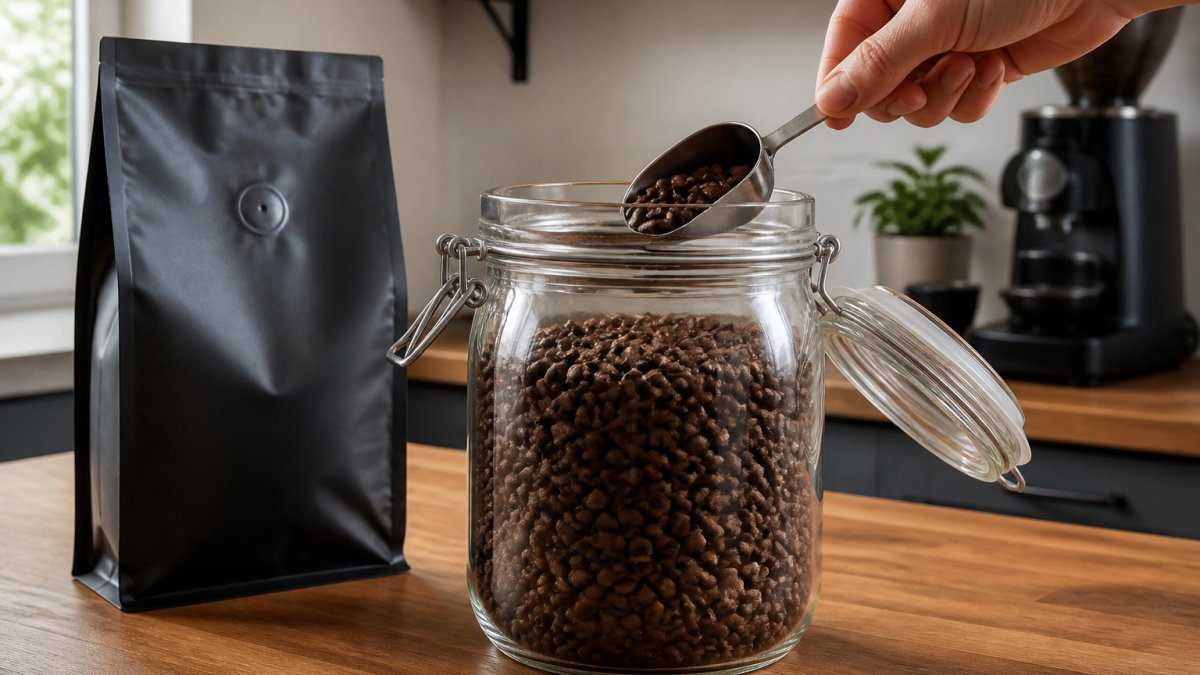
Seal quality. The lid should close with a gasket, silicone or rubber, that compresses against the rim.
Opacity. Light breaks down the oils in roasted coffee, so an opaque body is the safer choice. Clear glass or plastic is fine if the container lives inside a dark cupboard, because the cupboard does the light-blocking for you.
Capacity. Match the container to roughly one to two weeks of your normal use. A container that is too large leaves a big pocket of air above the beans, which speeds up staling.
One-way valves. Some containers include a valve to let carbon dioxide escape while keeping oxygen out. This matters most in the first few days after roasting, when beans are degassing heavily.
Cleaning. You want a container you can wash and dry fully between refills. Residual oils from old beans go rancid and taint the next batch. Avoid designs with narrow necks or hidden crevices that trap moisture.
How to evaluate a container before you buy:
- Does the lid seal with a gasket, not just a loose press fit?
- Is the body opaque, or will it live in a dark cupboard?
- Does it hold roughly one to two weeks of your normal use?
- Can you wash and dry it fully between refills?
- Does it fit where you actually keep your coffee?
Vacuum-sealed and nitrogen-flushed packaging is excellent for transport, but once opened, the clock restarts. Those formats protect the beans before you break the seal, not after. The same logic applies to any container: it slows staling, it does not stop it.
House Blend Coffee Beans – Medium Roast – Espresso & Filter – 250g 500g 1kg – UK →
Watch Out
Never tip new beans on top of old ones. The older beans stale faster and taint the fresh batch. Finish the old bag first, or keep them separate.
How Long Do Coffee Beans Stay Fresh?
Whole beans stay fresh for roughly two to four weeks after the roast date when kept in an airtight container in a cool, dark place. Ground coffee is closer to a week. Freezing extends that considerably.
The roast date matters more than any best-before label. A dark roast tends to fade a little faster than a medium or light roast, because the roasting process brings more oils to the surface. Lighter roasts often hold their character slightly longer.
| Storage Method | Whole Beans | Ground Coffee |
|---|---|---|
| Open bag, worktop | Days | A day or two |
| Sealed bag with valve, cupboard | 2-3 weeks | Under a week |
| Airtight container, cool and dark | 3-4 weeks | 1-2 weeks |
| Freezer, airtight and portioned | Several months | Several months |
Use your senses rather than a calendar. If the aroma has gone flat and the cup tastes hollow, the beans have had it.
Can You Freeze Coffee Beans? A Safe Workflow
Yes, you can freeze coffee beans, and it is the best option if you buy in bulk or drink slowly. Done properly, frozen beans can taste close to fresh for several months.
Portion before you freeze. Divide the beans into portions you will use in about a week. A week is a practical size: long enough to be worth the effort, short enough that the beans are not sitting out repeatedly.
Pack airtight and squeeze out the air. Use a heavy-duty freezer bag, a vacuum-sealed bag, or a small airtight container. Press or suck out as much air as you can before sealing.
Freeze immediately and keep the temperature steady. Put the portions in the coldest part of the freezer, away from the door where temperatures swing. Repeated freeze-thaw cycles are the main enemy here: each one draws moisture onto the beans and dulls the cup.
Thaw fully before grinding. Take out one portion, leave it sealed, and let it come to room temperature, usually a couple of hours on the worktop. Grinding cold beans can be uneven, and opening the bag while the beans are still cold lets condensation form on them.
Here is the workflow we recommend:
- Divide the beans into portions you will use in about a week.
- Seal each portion in an airtight bag or small container, squeezing out the air.
- Label each with the roast date.
- Freeze immediately, in the coldest part of the freezer.
- When you need a portion, take it out and let it come to room temperature still sealed.
- Grind once it has fully thawed, then brew.
Opening a frozen bag, taking a scoop and putting it back is the mistake to avoid. Moisture condenses on cold beans every time they leave the freezer, and that moisture dulls the cup.
Key Takeaway
Portion first, freeze once, thaw fully. That single habit keeps frozen beans tasting close to fresh.
Matching Your Storage Method to How Fast You Drink Coffee
The right setup depends on your pace, not on buying the fanciest jar.
- A bag every week or two: the original resealable bag in a cupboard is enough.
- A bag every three to four weeks: move to an airtight container, and buy 250g rather than 1kg.
- A bag every couple of months: freeze in weekly portions and thaw as needed.
- Two or more cups a day: order larger bags and top up from the freezer.
That last point is worth repeating. Buying a bigger bag saves money per gram, but only if you can keep it fresh. If you drink slowly, a 250g bag of Baffled House Blend will taste better at the end than a 1kg bag left open for two months.

Common Storage Mistakes to Avoid
Most stale coffee at home comes from a handful of habits. Here are the ones we see again and again.
- Keeping beans in the fridge. Damp air and food odours get in, and flavour gets out.
- Storing ground coffee for weeks. Grind fresh; ground coffee fades fast.
- Leaving the bag open on the worktop. Air and light do their work within days.
- Buying more than you can drink. A big bag is only a bargain if you finish it fresh.
- Refreezing thawed beans. Each cycle adds moisture and costs you flavour.
- Trusting a best-before date over the roast date. The roast date tells you far more.
Pro Tip
Write the roast date on the lid of your container. It is the one number that tells you whether your beans are still worth brewing.
If you want beans that arrive close to their roast date, that is what we aim for. Our coffee is roasted to order in small batches by our roasting partner, served daily in our cafés, and shipped across the UK with free delivery on orders over £35. Whether you drink a bag a week or a bag a month, we can help you pick a size and a blend that suits your routine.
Frequently Asked Questions
Should you keep coffee beans in the fridge?
No. A fridge is cold but also humid, and every time you open the door the beans are exposed to moisture and temperature swings. Both speed up staleness. Keep beans in an airtight container in a cool, dark cupboard instead. If you want cold storage, the freezer is the better option, but only if you follow a proper sealing and thawing routine so condensation never touches the beans.
Should coffee beans be stored whole or ground?
Whole beans every time. Grinding exposes far more surface area to oxygen, so ground coffee loses its aroma and flavour within days rather than weeks. If you buy ground coffee, keep it in an airtight container in a cool, dark place and use it within a week or two. Grinding fresh just before brewing is the single biggest upgrade you can make to how your coffee tastes.
How long do coffee beans stay fresh after opening?
An opened bag of whole beans keeps well for roughly two to four weeks in an airtight container in a cool, dark cupboard. After that, flavour fades rather than turning unsafe. For longer storage, portion beans into sealed bags and freeze them. Buying smaller bags more often, such as 250g rather than 1kg, is an easy way to make sure you are always drinking coffee near its best.
Does light or heat affect coffee bean freshness?
Both do, and quickly. Direct sunlight and warm spots such as the top of a fridge or beside a kettle or oven accelerate the loss of aroma and can make beans taste flat and papery. That is why an opaque container or a cupboard away from heat matters as much as an airtight seal. Cool, dark and dry is the rule to remember.
Storing coffee well is not complicated, but it does take a little discipline. Buy fresh, buy the right size, keep the beans sealed and cool, and freeze what you will not finish in a few weeks. Get those basics right and every cup tastes closer to how it did on day one. Browse our freshly roasted coffee beans and find a bag that fits how you actually drink coffee.