Best Coffee Beans for Home Brewing: 2026 Guide
Sep 28, 2026
Table of Contents
- How to Choose the Best Coffee Beans for Home Brewing
- Single Origin vs Blends for Home Brewing
- Coffee Grind Size Guide for Beginners
- How to Store Coffee Beans for Maximum Freshness
- Decaf and Everyday Options for Home Brewing
- Sustainability and Budget: What Your Money Buys
- Frequently Asked Questions
Last Updated: September 28, 2026
How to Choose the Best Coffee Beans for Home Brewing
The best coffee beans for home brewing are matched to your brew method and roasted recently, ideally within two to four weeks. This guide from Baffled Coffee covers roast dates, origins, grind sizes and storage.
Match the Bean to Your Brew Method
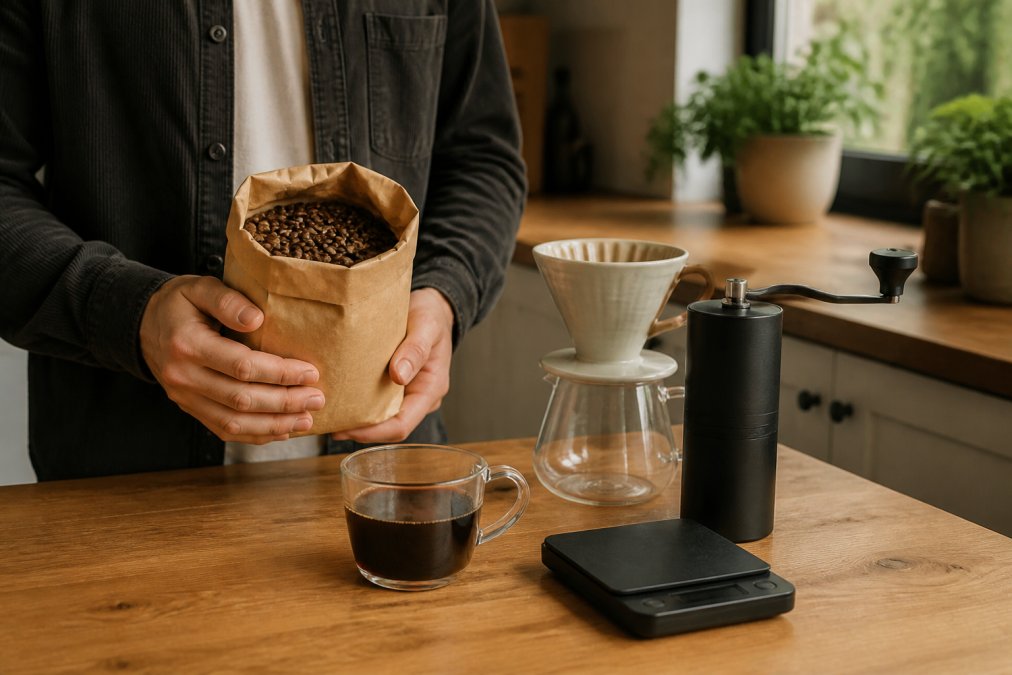
Different brewers extract differently, so the bean should suit the kit. A cafetière or drip machine works well with a medium roast, while espresso rewards a slightly darker, more developed roast that holds up under pressure. Cold brew suits darker roasts too, since long, cold extraction pulls sweetness rather than acidity.
Why Roast Date Beats Everything Else
A roast date tells you far more than an origin story or a fancy label. Coffee degasses after roasting, releasing carbon dioxide that interferes with extraction: too fresh brews unevenly, too old fades. The sweet spot is roughly 5 to 28 days after roasting.
Pro Tip
If a bag has no roast date, treat that as a red flag. A best-before date six to twelve months out tells you nothing about when the coffee was actually roasted.
Single Origin vs Blends for Home Brewing
Single origin coffee comes from one region, farm or cooperative, while a blend combines beans from multiple origins. Neither is better; they do different jobs.
| Option | Best For | Flavour Character | Consistency |
|---|---|---|---|
| Single origin | Exploring flavours | Distinct, region-specific | Varies by harvest |
| House blend | Everyday brewing | Balanced, rounded | High, repeatable |
| Decaf | Evening drinking | Milder, still sweet | Depends on process |
Coffee Grind Size Guide for Beginners
Grind size controls how fast water moves through the coffee bed, and therefore how much flavour you extract. Get it wrong and no bean, however fresh, will taste right: too coarse and water races through for a thin, sour cup; too fine and it stalls, over-extracting bitter, hollow notes.
Starting Grind Sizes by Brew Method
These are starting points, not fixed rules, the middle of a dial you will nudge from there.
- Cafetière (French press): coarse, roughly the texture of sea salt, with visible individual fragments
- Filter and drip machine: medium, like table salt
- Pour-over (V60, Chemex): medium-fine, closer to caster sugar than table salt
- AeroPress: medium-fine to fine, depending on steep time
- Espresso: fine, like caster sugar but with a slightly gritty feel between the fingers
- Cold brew: coarse, similar to cafetière, because long cold steeps extract slowly
- Moka pot: fine, but slightly coarser than espresso to avoid clogging the filter
Adjusting Grind for Roast Level
Once you have a baseline, shift it for the bean:
- Light roasts: go one or two steps finer than the baseline. The denser bean resists extraction, so you need more surface area and contact time.
- Medium roasts: the baseline is usually correct.
- Dark roasts: go one step coarser. The bean is more soluble and releases bitters quickly, so a finer grind tips it over the edge.
- Decaf: often needs a finer grind than its roast colour suggests, because the decaffeination process can make beans more brittle and less soluble.
A Simple Calibration Routine
Change one variable at a time:
- Brew with your current setting and note whether the cup is sour (under-extracted) or bitter (over-extracted).
- If sour: grind finer by one small step and brew again.
- If bitter: grind coarser by one small step and brew again.
- If it tastes weak but not sour: you may be under-dosing rather than grinding wrong, check your coffee-to-water ratio before touching the grinder.
- Repeat until the cup tastes balanced: sweetness in the middle, acidity at the edges, no lingering harshness.
People often chase grind size when the real problem is dose or water temperature. Fix those first, then fine-tune grind.
Pro Tip
If your grinder has numbered settings, write down the number that worked for each bean. When you buy that bean again, you have a starting point instead of guessing from scratch.
Whole Bean vs Pre-Ground
Whole bean coffee stays fresh far longer because the flavours are locked inside the bean. Once ground, coffee stales within days. Grinding just before brewing gives noticeably better results, and it is the only way to adjust grind for roast level as described above.
Watch Out
Buying a large bag of pre-ground coffee and using it over two months is the fastest way to waste money. The last third will taste nothing like the first.
Water Chemistry: The Variable Nobody Mentions
The water you brew with is roughly 98% of the cup by weight, yet almost no guide addresses it. Two things matter:
- Mineral content: water that is too soft extracts poorly and tastes flat; water that is too hard can taste chalky and mute acidity. A middle ground of moderate hardness tends to suit most beans.
- Alkalinity: high alkalinity buffers the acids in coffee, which flattens the bright, fruity notes that light roasts are prized for. If your light roast tastes dull at home but vivid in a café, your water is the likely culprit.
Key Takeaway
Grind size is the lever you adjust most often, but roast level, dose, water temperature and water chemistry all sit upstream of it. Fix those first, then dial in the grind.
How to Store Coffee Beans for Maximum Freshness
Storing coffee well comes down to slowing three processes: oxidation, degassing and moisture uptake.
- Oxidation: oxygen reacts with the oils and aromatic compounds in roasted coffee, replacing sweetness and fruit with cardboard and stale paper. This is the main reason coffee goes flat.
- Degassing: freshly roasted beans release carbon dioxide for days. Some is necessary, brewing the day of roast produces uneven, foamy extraction, but too much time and the bean loses the volatiles that carry flavour.
- Moisture: coffee is hygroscopic, absorbing water from the air, which accelerates staling and can introduce off-flavours.
What Actually Works
- Airtight, opaque container at room temperature. A one-way valve bag or sealed canister in a cupboard is ideal, the valve lets carbon dioxide escape without letting oxygen in.
- Away from heat and light. Not on top of the fridge, beside the kettle, or on a sunny windowsill.
- Buy in amounts you will use within two to four weeks. Two smaller bags beat one giant one, because every opening exchanges the protective atmosphere for room air.
- Keep the bag sealed between uses. Squeeze out excess air, or transfer to a smaller container as the level drops.
What Does Not Work
- The fridge. Moisture condenses on cold beans when you take them out, and coffee absorbs other odours in there. This is the most common storage mistake.
- The freezer, done casually. Freezing can extend storage for months, but only in a fully sealed bag with the air pressed out, and only if you let beans reach room temperature before grinding. Opening a frozen bag repeatedly introduces moisture. Portion into single-brew amounts first.
- The hopper of a grinder. A hopper is a display case, not a storage vessel, beans left in it are exposed to air and light continuously.
How Long Beans Stay Good
A working timeline for most beans:
- Days 1-4 after roast: degassing heavily; brews can be uneven, especially for espresso.
- Days 5-28: the sweet spot for most beans and most brew methods.
- Days 28-60: flavours begin to fade; still drinkable, but the brightness and complexity decline.
- Beyond 60 days: noticeably stale, though darker roasts hold up slightly longer than light roasts because they have less volatile acidity to lose.
These are guidelines, not rules: a bean stored well at day 40 can beat one stored badly at day 10.
If a bag has no roast date, treat that as a red flag. A best-before date six to twelve months out tells you nothing about when the coffee was actually roasted, and you cannot judge freshness without it.
Storage and Sustainability: What Your Money Buys
Storage and sourcing are connected more than they appear. Coffee that has travelled slowly, sitting in a warehouse, crossing an ocean, waiting on a shelf, arrives partway through its useful life. A roaster who roasts to order and ships quickly gives you more of the bean's good window, value that does not show up on the price tag.
Budget-to-Quality: Finding Your Daily Drinker
Not every bag needs to be a special occasion. A practical way to think about value:
- Daily drinker tier: a reliable blend or a straightforward single origin, roasted recently, bought in a size you will finish within a few weeks. This is where consistency matters more than novelty.
- Weekend tier: a single origin with a distinctive profile, a washed Ethiopian, a natural Brazilian, for when you want to taste something specific.
- Special occasion tier: a micro-lot or competition-style bean, bought in a small bag and brewed carefully.
Key Takeaway
The cheapest bag is rarely the cheapest coffee. Stale beans need more per brew to taste of anything, so you use them faster, and poor storage accelerates the whole problem.
Decaf and Everyday Options for Home Brewing
Decaf has improved enormously and is worth keeping on the shelf. Look for the Swiss Water Process, which removes caffeine using water and carbon filters rather than chemical solvents, preserving more of the bean's natural sweetness.
Sustainability and Budget: What Your Money Buys
The cheapest bag is rarely the cheapest coffee. Stale beans need more per brew to taste of anything, so you use them faster.
Baffled Coffee keeps things simple: balanced, reliable flavour, roasted by people rather than machines, and no jargon. Their blends and single origins are built for everyday home brewing, and their decaf holds its own.
Frequently Asked Questions
Does the roast date really matter for home brewing?
Yes. Coffee beans release carbon dioxide for roughly 7 to 14 days after roasting, a process called degassing, and peak flavour usually sits between 4 and 21 days after the roast date. Supermarket bags often carry a best-before date rather than a roast date, so you cannot tell how old the beans are. Look for a printed roast date and buy from roasters who roast in small batches to order.
How do I choose between single origin and coffee blends for home brewing?
Single origin beans come from one region or farm and highlight a specific flavour profile, such as notes of citrus or berry from an Ethiopian washed process. Blends combine beans to create a consistent, balanced cup that tastes the same every time. If you want to explore how processing method and origin change flavour, try single origin. If you want a reliable everyday cup, a house blend is the safer choice.
What is the best coffee grind size for my brew method?
Grind size should match how long water contacts the coffee. Espresso needs a fine grind, drip coffee and pour-over sit in the medium range, and a French press or cold brew needs a coarse grind. If your coffee tastes sour or weak, grind finer. If it tastes bitter or harsh, grind coarser. A burr grinder gives you more consistent particles than a blade grinder.
How should I store coffee beans to keep them fresh at home?
Keep beans in an airtight container away from light, heat and moisture. A cupboard is better than a countertop next to the kettle, and the fridge or freezer only works if the container is fully sealed and you let beans reach room temperature before grinding. Buy in smaller amounts more often rather than a large bag, so you finish the coffee while it is still within its best window.
Choosing beans can feel like a maze of labels, origins and roast dates, but the rules are simple: buy fresh, match the bean to your brewer, and store it well. Baffled Coffee roasts in small batches to order, offers blends, single origins and decaf with a balanced, no-fuss flavour, and delivers quickly across the UK with free shipping on orders over £35. Get started with Baffled Coffee and taste the difference fresh roasting makes in your daily cup.